Tuesday, October 23, 2012

#28 Hong Kong, China 10-21 Look who's shopping now!

2496  Bank of China building in Hong Kong.  Opened on 8-8-88 because the Chinese believe that 8 is a lucky number.  Actually it’s in Kowloon but they refer to the island (actual Hong Kong), Kowloon (on the mainland) and the New Territories as Hong Kong.

2510  This is an admittedly poor shot of the tai chi trio I spent some time watching in Kowloon Park.  The men are just about to execute the forearm block that she has just finished.  Their backsides were at least 18 inches off the ground when they did.  It’s not so amazing that she can get that low, but to spring up from there as her raised right arm delivered an upper cut punch was amazing.

2526  Old Girl and her cat Ting Ting from the Hong Kong Avenue of Comic Stars.  Her author/artist describes here as, “not a girl and not yet a woman who always keeps a young mind.”  Here comic Old Girl’s Diary describes how spicing ‘up her dull life is Old Girl’s everyday task.”

2537  Miss 13 Dots is the only daughter of a of a Hong Kong millionaire.  Her author/artist describes her as being ‘independent, lively, avant-garde and fashionable”.  She also ‘cares about people with her charitable mind and a strong sense of justice’.  She ‘likes to conjure up unusual ideas and act chivalry with her friends.’   In the background you can see a whole series of statues that have a martial arts theme.  To be honest, they all look alike to me.

2568  The Star Ferry Terminal, and icon of Hong Kong. 


Oct 21 - Hong Kong, China.  Today Diana’s going on a city shopping tour that is of almost no interest to me.  Actually that’s not exactly the truth; it’s of no interest to me whatsoever.  So today’s a rare and wonderful opportunity to spend the day entirely immersed in the local scene.  Last time we were in Hong Kong it was raining and cold.  I had another day to myself then and I went gopher touring.  Gopher touring is where you buy a subway pass and just ride it until you get to a station that looks like it might be an interesting part of town.  You get off and go up to the surface.  If it’s still raining, there’s no cover and the area doesn’t look interesting you go back down, ride some more and repeat the process until you find somewhere you want to spend some time.  Last time I found a neighborhood where there were predominantly martial arts shops, including Tai Chi and Kung Fu schools and the supply shops for their gear.  There were also a lot of little restaurants where they cook in the front window.  Very photogenic and interesting.


Today however Diana has given me a list of necessities she needs for the trip, mainly medical supplies and getting her sunglasses adjusted.  You might wonder how I’m going to get her sunglasses adjusted without taking her head with me.  It’s simple actually.  I just put on her glasses and feel how uncomfortable they are on me and then get the tech to adjust them to the same level of discomfort.  I don’t mind doing this at all because if I didn’t have the list I’d be walking around town anyway.


Diana’s tour left the ship at 8AM and so did I.  When you disembark on tours here they let you off on A deck where the busses can get right out on the pier.  When you go off on your own you get off on deck 2 and the gangway leads you directly into the second floor of the Harbor Center shopping mall.  It’s a pretty upscale place with cafes, restaurants and shops.  Right down the stairs from the end of the gangway was a Toys R Us.  In fact the entire first floor of this particular hall is completely populated by children’s stores, clothing, toys and the like.  Lots of interesting shopping for all the Grandmas on the ship.  The benches in the mall are pretty nice as well.  In the kids shop hall the benches are all huge chocolate éclairs. 


It’s Sunday so there’s not much open at this hour.  My first destination is Kowloon (Dragon) Park.  It’s right downtown and only about half a mile from the ship.  You just walk along the waterfront until you get to the Peninsula Hotel, sister to the place we stayed in Beijing, turn left on Nathan Road, the busiest shopping street in the city, and walk about 8 blocks and you’re there.  It’s a fairly large park but the reason I’m heading there is that it’s one place in the city you can see martial arts and tai chi all day long.  I’m sure that I’m a bit late for the big crowd but there will be something going on somewhere in the park.


I hit it big.  There were people doing all sorts of exercises, Qi Gong and the like, but there were three people doing a very strenuous style of tai chi that lets you see its martial arts roots.  I a woman and two men and the woman was clearly superior in her form and flexibility.  On some moves she was so low to the ground she appeared to be doing the splits but the next second she’d rise up to finish the form just as fluidly as if she had gotten up from a chair.  I sat and watched for a while and almost missed the shot of the day.  It’s not a good picture but I caught her just before she sprang up to finish the move.  The two men are just getting ready to execute the forearm block that she’s already made along her left leg.  If I hadn’t see it I might not have believed it.  This was no young woman.  She had to be at least 60.  Amazing.


I walked over to the lake where they have quite a few waterfowl types, geese, ducks and flamingoes.  Diet must not be right they were not very pink.  When they’re eating the brine shrimp they love so much they can really get dark.


At the northeast corner of the park I ran into a temporary art exhibit ‘Hong Kong Avenue of Comic Stars.’  It was larger than life figures done by comic artists, most of them probably popular in the ‘graphic novels’ here in China.  Many were in martial arts poses but some were obviously humorous characters.  With names like Old Master Q, Old Girl, Little Horse (a young girl) and Miss 13 Dots (definitely not a young girl) the characters were original and, aside from the martial arts characters, kind of charming.


After spending about 1 and a half hours in the park I walked downtown again to see if the drug stores were open yet.  Not quite.  Actually the stores were open but the pharmacist does not come in until 11AM on Sunday.  There’s a McDonalds right across the street so I dropped in for a sausage McMuffin with egg and coffee.  It’s actually amazing how, no matter where you are they always taste the same.


At 11AM I hit the pharmacy again and managed to get a couple of bottles of Robitussin DM and a few packages of Sudafed.  Both are kept behind the pharmacy desk and that’s why I had to wait for the pharmacist.  It was a very nice lady and unlike the USA, pseudoephedrine is not yet a semi-controlled chemical.  I was able to get enough to last for the rest of the trip.  Diana’s chronic respiratory issues force her to take a lot of this type of medicine and she couldn’t stock up enough to last for the trip.


I think her sunglasses will be ok; they hurt just the right amount when I tried them on.


A leisurely stroll back to the ship got me there just after 2PM.  I had a cup of tea and part of a green tea/red bean paste bun that was so unusual I bought it at a café in the Ocean Center to use up the last of my HK$.


The sail away was very nice.  We were docked in Hong Kong across the channel from Kowloon and the New Territories.  As we sailed out we passed the Star Ferry Terminal that I remember seeing in an early James Bond movie, I just can’t remember which one.  Those green and white ferries look just like they did in the ‘60s and probably long before that.  They’re steam driven and have a bow and propeller at each end so they don’t have to turn when leaving the pier; they just go back and forth.

328


Monday, October 22, 2012

#27 Con't yet again. It was a great show!!

2457  These are the musicians playing the traditional instruments.  Excellent sound.

2462  The dragon dance troupe forming a square with the dragon’s head in the center.  You can see the ball he chases and its operator on the right.  I decreased the contrast of the photo to make the dancers more visible.

2470  These are the ribbon dancers twirling with their 30-foot scarves.

2471  This is the mask dancer.

2482  The cast of the show with the lights up.


Oops!  Forgot to include info about the onboard show this evening.  First a duo played some ethnic music on a plucked horizontal harp and a three string violin type instrument played like a cello, vertically.  They did throw in one John Denver song which sounded a little strange on these instruments. 


Next a dance team performed a dragon dance.  This very typical Chinese dance involves a dragon chasing a ball around the stage.  The dancers controlling the dragon wave it in complex designs that involve them having to hop over the streaming dragon and duck so they don’t interfere with its motion.  Sort of like jump rope using an 18 inch thick rope.  The dancers have to be pretty agile but since the dance is performed in the dark with the luminescent dragon lit by black light it’s very difficult to see them moving.  Every now and then they would form a shape, triangle or square, with the dragon’s body and have the head staring out at the audience.  They were very energetic.


Two ladies in traditional dress performed the Ribbon Dance.  They gold a scarf like object that appear to be about 30 feet long around their shoulders and make it form designs by manipulating it.  If you’ve ever seen the rhythmic gymnastics at the Olympics, it’s a lot like the ribbon on a stick style but the apparatus is one long scarf instead of two separate ribbons on sticks.


The last act was uniquely Chinese.  The national art form is the Mask Dancer.  They wear elaborate costumes with a long cape and ornate headdress.  They walk and dance in a very stylized way and every so often the mask he’s wearing changes.  The trick is they do it so fast that you don’t see it happen.  One second he wearing a red and white mask, next second it’s blue and black.  These are full face masks, not small by any means.  What I’m wondering is where he keeps them all, he must have worn about 12 different ones over the course of the performance.  Oh, I forgot the acrobat dressed all in purple that would flash across the stage every now and then doing various flips, jumps, cartwheels and dives.  The mask dancer walked in a very deliberate but quick heel to toe step that reminded me of race walkers but without the elaborate hip gyrations needed to go really fast.  In fact, his body seemed to float under his cape.  Every not and then he’d grab one or both of the almost 5 foot long antennas, made primarily of a pheasant tail feather with a peacock eye at the base. that stick straight up from the top of his head and manipulate it in some way.  At first the audience didn’t know exactly what to make of the whole thing but they warmed to him completely by the time he was half way finished and he got a great round of applause at the end.  Anything that’s too different from what you might see in North America often confuses many of my fellow travelers and sometimes they never recover.  Sad, but true.


As they closed the show everyone came back on stage and I was glad they did.  The stage lights were on and the mask dancer and dragon dancers joined forces.  With the lights up you could see the work the dragon dancers have to do to make the dragon writhe in the designs they form during the dance.  The mask dancer came armed with a large bright blue flag with which he seemed to be shooing the dragon and the ball around the stage. 


It was a great show as these local shows that come on the ship usually are.


#27 Cont'd More Pictures

2424  This is the altar of one of the temples in the Macau complex.  You can see the incense sticks in the bowl as well as the flower and candle offerings.  If you look at the top of the picture on either side above the wooden disks suspended from the ceiling you can see the bottom of two incense coils.

2426  The dog dancers and their band.  The band consists of drums,, gongs and cymbals

2432  This is the innocent looking but wonderful pastry that I first tried in Belem, Portugal.  Not really surprising that it’s here in China as the Portuguese held Macau for hundreds of years.

2443  In this shot of the temple complex you can see part of three temples.  Just above the wall on the left is the roof of one temple.  The second temple is the pink one in the foreground with the circular window.  That the one I sent the altar picture of.

2444  Various sizes of incense coils in the sales area.

Sunday, October 21, 2012

#27 Hong Kong-Macau, China 10-20 Where's immigration?

2367  Diana and I on the TurboJet Ferry.  Look at those roomy comfortable seats.

2371  Part of Macau.  The golden flame like building is the Lisboa Casino.

2389  This is the front façade of Saint Paul's Cathedral

2407  View of Macau from the 360 Restaurant on the Macau Tower.


Oct 18 & 19 – At Sea.  Once again, not one but two days to catch up on my photos, writing and rest.  Nothing exciting happened during this time period except that on the 19th they had another Mongolian cookout for lunch but the Lido pool.  Yum!!


Oct 20 - Hong Kong, China.  Today we may set a record for visas stamped in our passports in one day.  In the old days in Europe it was no problem to collect a bunch of stamps in a day but with the Euro Zone in effect, it's not easy to get you passport stamped unless you run in and out of Switzerland, Norway, Lichtenstein, Luxembourg or Andorra.  Today we will have entered Hong Kong, left Hong Kong, entered Macau, left Macau and re-entered Hong Kong.  That's five entry and exit stamps in less than 10 hours.  Not bad.  The Chinese take all this very seriously and since both Hong Kong and Macau have become special protectorates of the Chinese they also take it the same way.


We've been to Hong Kong a couple of time and decided to go to Macau this time.  Just like the British in Hong Kong, the Portuguese in Macau had a lease on the area and were separate from China.  Both leases have now expired and both have become special protectorates of China and will be for 50 years at which time their status will be reconsidered.  If the Chinese are half as smart as I think they are they won't change much.  Hong Kong is the financial center for Asia and Macau is the gambling mecca.  Gambling is illegal in China and Hong Kong but legal in Macau. 


If you've ever been to Las Vegas you know that Asians of all types are big time gamblers and the same goes here.  Macau only has 34 casinos but the total take there is larger than Las Vegas, which has almost three times that many.  The casinos here are all huge.  And I do mean huge.  Several represent Vegas interests.  There's a Venetian, an MGM Grand and a Wynn casino.  The rest appear to be European and Asian enterprises.


Hong Kong has a definite British flair but it is much more Chinese than British.  Macau on the other hand is definitely influenced by its Portuguese past.  They colonized the area and ruled it for over 400 years before it reverted to China in 1999.  In some sections of the area you could easily be in Lisbon.  The architecture of whole neighborhoods is in the Portuguese style.  It has a more relaxed, easy going feel.  The people aren't rushing past, bumping into you like they do in China and Hong Kong.  Everyone gives everyone else space.


I picked up our passports from the front desk and at our appointed time we were in the Queen's Lounge preparing to leave.  After being scanned off the ship we boarded a bus for what wound up being a one-third of a mile trip to the fast ferry pier.  It was here that we cleared immigration to depart Hong Kong.


Macau is about a one hour trip from Hong Kong by fast ferry.  The company that operates our ferry is First Ferry Macau and the ferry is called the TurboJet.  It's an all inside ferry because of the speed but the seats are large and comfortable and the air conditioning works very well.  The ferry is fast.  The water is pretty smooth this morning and the captain can push the ship to its max.  Sure enough, about one hour later there we arrived at the pier in Macau and it's here that we cleared immigration into Macau.  Both clearances were pretty quick but, as it's early Saturday morning, the ferry is nearly full with Chinese going to Macau for the weekend. 


After we boarded our bus we headed immediately to New Macau, built on land reclaimed from the sea, to stop at the Venetian Casino.  On the drive there we could see them hard at work setting up temporary seating and barricades for the Macau Grand Prix.  It's often referred to as the Monte Carlo of the Far East because of this race and the large fancy casinos.  I can tell you for sure that the coffee is less expensive here than in Monte Carlo.  To sit on the patio of a café across the square from the Grand Casino in Monte Carlo I had to pay the princely sum of 15€, at the time about $19.50US for what could best be described as a mini-mocha.  Of course, it came with a small sugar cookie so I guess I wasn't overcharged by much.  Here in Macau Diana got a large (Vente) mocha for $5US and got some Hong Kong $ change. 


It can be a bit confusing if you're not careful when talking about money here.  Hong Kong and Macau both use dollars but each has its own.  So if you throw in US dollars you have three different currencies in play all with the same name.  Everyone shorthands this by calling our dollars US, Hong Kong dollars HK and Macau dollars Macau.  Luckily the HK and Macau dollars are worth almost exactly the same amount.  If you go to the bank and trade in $100Macau you get $103HK.  So everyone just treats them both as if they are 7 of theirs to 1 of ours.  For some reason you feel like you're getting a good deal when you get a $70 t-shirt for $10.


Because so many people come from Hong Kong to gamble, everyone in Macau will accept HK$ and give change in the same currency.  I had to ask for a few Macau coins in my change to get a souvenir.  Actually US$ were readily accepted everywhere I tried to spend them.  I had gotten some HK$ so small purchases were made using that.


The visit to the Venetian was ok but having seen the one in Vegas I can safely report that they are pretty much the same place.


Our next stop was at the ruins of Saint Paul's Cathedral.  It's an important sight because the Jesuits (Society of Jesus) settled in Macau in 1565.  By 1594 they had established several schools and in that year they founded the College of the Mother of God (Mater Dei), the first western style university in the Far East.  When the Jesuits were expelled in 1762 the building was abandoned and later became home to military battalion.  In 1835 a fire erupted in the kitchens of the barracks that destroyed the entire compound.  In the 90s the front façade was restored and the crypt was turned into a museum.


The four-tiered façade give us a feel for what the cathedral must have been.  Now were finally talking about something I understand, church architecture, specifically cathedrals of the 15 and 1600s.  It was a typical three nave design with the central aisle being wider than the side aisles as well as at least 50% taller.  The interior of the standing façade shows that there was a choir loft above the entrances and probably aisles around the second floor.  Judging by the ornamentation on the façade it must have been a pretty grand place. 


The lower tier of the front façade has the typical three entrances, the central one being wider and larger.  Not much going on there except for the IHS over the outer doors and the inscription 'Mater Dei' over the larger central door.  The next tier up is dedicated to the four Jesuit Saints, Francisco de Borja, Luis Gonzaga, Francisco Xavier and Ignatius, the founder of the society.  I know of Catholic schools named after everyone but Borja.  Either my knowledge is deficient or he was robbed.  The tier also has symbols of the work of the society, missions, etc.  The next tier up is dedicated to Mary and events in her life.  The top tier is dedicated to Jesus and his work in securing the possibility of redemption for mankind.  In the tympanum at the top is the dove of the Holy Spirit.  Any symbol of God, the Father seems to be absent.  You think He would have figured in there somewhere.


The carving is also rich in symbolism.  For example, there's a ship being guided by the sea star to show the Jesuits commitment to foreign missions and the statue of the young Jesus is surrounded by the implements of His crucifixion, the crown of thorns, hammer, the nails, the whip and the spear.  The interior must have been splendid.


Next we drove by the Purto do Cerco Gate that stands at the old border between Macau and China.  It's still used because there are some formalities to go between the two for foreigners but Macaoanese and Hong Kongese just pass through.  I know, but that's what our guide calls each group so that's what I'm using.


Then it was on to the Macau Tower, the tenth tallest free standing tower in the world.  We're stopping here because we're going to eat lunch on the top.  They have one of those revolving restaurants up there.  The only thing higher than the restaurant is the TV tower and at the base of the TV tower is the bungee jumping tower.  It's certified by the Guinness Book of World Records as the highest architectural bungee jumping site in the world.  Lunch is going to be a buffet and that's fine with me.  The food is usually better than a set lunch on these tours. 


The restaurant's name is 360˚ and the views from there were very nice.  It moves so slowly you can't really feel it but you can see the motion if you look out the floor to ceiling windows.  Only the eating area moves so you didn't have to search for the buffet you wanted to select from.  Just wait a few minutes and it will be just up the steps from your table.  They had oriental, Indian, English and Portuguese cuisine to choose from.  That is, in addition to the salad, dessert, fruit and bread bars.  The Oriental food included food from several countries, sushi and dim sum in addition to the Chinese, Thai and Japanese choices.  I liked the fragrances coming from the Thai and Indian bars and that's what I chose for the main meal.  I had to sample the dim sum and to be honest, what they serve in Chinatown in Los Angeles is better than any I've ever had in China.  This was pretty good but still not as good.  I didn't try the sushi, it was all cut rolls and while they are ok, I prefer nigiri or te maki.  The lunch was very good and I'm sorry I didn't take any pictures of the restaurant, just out the window.


From the tower we drove to the Macau Temple complex.  It's sort of like a planned community for temples.  They have about 8 temples in a very small area and each is either to a different god or belief system.  If you wanted to cover all the bases of Eastern Religion this is the place to come.  Each small temple scattered up the hillside had its own shop selling incense, ribbons to leave on the premises, charms, amulets and I don't know what else.  If you're really serious they have the incense coils for sale here.  The first I've seen this trip.  The incense is about .75 of an inch thick and coiled like a rattlesnake but of course there's a gap between the coils or they'd all burn at once.  You can buy them in one week, two week and one month sizes.  Now that's a serious amount of devotion to show to the particular deity you're honoring.


When we arrived there was a band playing and a Chinese dog dancing.  The dog was the 2-man operated variety.  They seemed to be having a good time, I know the temple visitors were.  Just down the street there was a bakery.  You know my reputation for wanting to try the special local treat.  Our guide said they made a wonderful egg custard pastry.  Sounded like just like the ticket.  It was even better than I hoped.  The 'egg custard' wound up being exactly like one of my favorite pastries in the world, the pasteshe (sp?) de Belem.  It's Portuguese and I have no idea how to spell it but I'm pretty sure it means 'pastry of Bethlehem'.  Actually I'm sure about the Bethlehem part it's the pastry part I'm not sure of.  (I'm expecting a note from my friend Jan about how badly I butchered this.)


Anyway the pastry is a small cup of crust filled with the creamiest custard that's baked until it's a little scorched on top.  I got one for Diana and one for myself.  No splitting this goody.  At about 2.5 inches in diameter it's not really big enough.  I tried to split one in Lisbon and the flaky crust just disintegrated making for messy eating.  I'm not making that mistake twice.  Yikes, it was good!! 


After that it was the ferry back to Hong Kong.  Just reverse the explanation of the trip over and you've got it.  It was a good but long day and it was nice to get home to the ship.


Friday, October 19, 2012

#26 Cont'd More Pictures

2319  This is Diana mailing our post card at the Qing Dynasty mail box.  Except for the dragon on the post and two Chinese characters on the box it could be any mailbox in England during that era.

2329  The apothecary shop’s inventory in drawers and jars.

2331  Some specialty items deserve a more prominent display.  This is the ginseng and two snake elixir.

2352   A lady stops off for some take out.  I don’t know exactly what meat is wrapped up in those two different leaf bundles (one is in the foreground and the larger one is next to it) but every butcher was selling them.  At 3 yuan a bundle they’re certainly not expensive.  That’s just a little over 50 cents.

2362  This is the Shanghai skyline from the deck of our ship.  The weird tripod building with the balls attached is the local TV tower.  It’s purported to be the third tallest, free standing tower in the world.

#26 Shanghai-Zhujiajiao, China 10-17 'Smooth as silk'

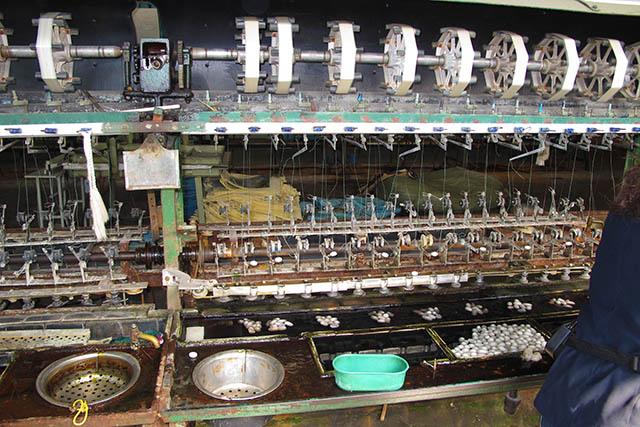
2228  This is the machine that unwinds the silk cocoons.  You can see the 10 cocoons in the water at the bottom of each collector.  The cocoon inventory is in the square tub in the foreground.  The larvae of the silk worms are in the little turquoise tub on the shelf.

2261  Here’s our canal boat pilot, on the phone.  Can you hear me now?

2266  The Fangsheng Bridge, the largest bridge in the city.

2288  The main altar at the Daoist Temple.  The happy couple seem to be enjoying themselves.

2298  One of the minor altars.  You can see the Yin-Yang symbol on the front sign.


Oct 17 – Shanghai-Zhujiajiao, China.  Once again we are heading out of Shanghai to the city of Zhujiajiao, a traditional waterside town.  This time we go the whole distance by bus.  Fortunately it’s not so far, unfortunately it’s through all of west Shanghai again.  The trip was going to take an hour and a half but we has just gotten started, read that as ‘spent one-half hour driving in miserable traffic’, when our guide got a phone call from one of his cohorts that there was a big problem with the road ahead and he should probably switch to our afternoon itinerary for the morning in the hope that the traffic would clear up.


So we reversed course and headed back a little way to stop at the silk factory and then have lunch.  The silk factory was interesting.  The first thing they did was show us jars of preserved specimens showing the stages of development of the silk worm.  Then we went into a room with a short runway and they put on a fashion show of silk clothing, nothing for men of course.


They still don’t have a really modern way to unwind the silk threads from the cocoon.  First they treat it in hot water to loosen the substance that holds the cocoon together.  This also kills the larval stage of the worm that spun the cocoon.  They hold back 10% of each year’s crop to get the eggs that will produce next year’s crop.  When the silk moth cuts it way out of the cocoon it makes a hole in one end that slices the silk into thousands of small useless pieces. 


The threads of ten cocoons are combined in one process that makes a very strong cord of silk as it winds onto the unraveling machine.  The cocoons bob around in a small bowl of water as the machine collects the silk.  A girl watching the process immediately inserts another cocoon in the bowl when one runs out and puts the dead larva into another bowl.  These larvae are stir fried and eaten or ground up and put into facial treatments.  Our guide said that the fried larva tastes like peanuts.  At least she didn’t fall back on the usual suspect, chicken.


Next stop the showroom, of course.  I did get a nice silk tie for $28, a great price really.  Diana bought a scarf, vest and some larger wrap of some kind.  Lunch was upstairs from the showroom.  Again the round table with spinning center was the order of the day.  The usual suspects were on the menu but this time we had steamed pork dumplings (shu mai), and fried whole fish bream (the dish is called Squirrel Fish) sweet and sour sauce.  Squirrel Fish is a traditional food in this area.  Another very nice lunch.


Well the moment of truth has arrived.  We are back on the road headed to Zhujiajiao.  I worked with a Chinese economist whose first name was Jiajiao; everyone was having a hard time trying to pronounce it until he said, “Just say G. I. Joe and you’ll be close enough for me.”  He was giving us a break because the ‘I’ should be short ‘ah’ and the Joe really should be gajo where the ‘a’ is short.  Our guide was shocked when I added the Zew to the front and had no trouble with the name.  Thanks for the assist Joe.


Actually traffic was not bad by local standards and we were at the city in about an hour.  Our guide gave us a break and had the driver take us to the city and drop us off before returning to the parking lot.  After yesterday’s treks to and from parking lots that was a real treat.


We started off by crossing one of the city’s 36 bridges, a small one of just one arch constructed of stone.  A very short way down the canal we came to the boat dock and were put on them in groups of six.  The boat is like the small boats on West Lake, powered by a man on the aft deck with a sculling oar.  I was sitting at the back of the small covered space and looked up one time to see him talking on his cell phone.  He was sculling with his right hand and holding his cell phone to his right ear with his left hand.  I just had to laugh.  Different country and culture, same habits.


As we rode along the canal we passed shops and restaurants, most with a second floor for additional selling or seating space.  There were seafood, meat, candy, fruit and clothing stores.  Families were walking along the sidewalks in small groups, many of which seemed to be at least three generations.  Lots of children.  A very picturesque setting.  Most of the buildings are well over 100 years old, some over 300.


The village is not on the ocean but borders Dianshanhu Lake so the water is fresh, if not really clean.  I’m very surprised that no one has called it the Venice of China.  I guess there are too many canalled cities for any one of them to make that claim.


On the small square where we got off our little boat there’s a Daoist (often Taoist in English writing) temple the first one we’ve seen on this trip.  Dao (the Way) incorporates the traditional concept of the ordered universe, Yin and Yang, and that symbol is prominently displayed in the temple.  Inside the gate you enter the typical courtyard.  This one has rooms built into the side walls.  The rooms contain the ‘protectors’ of the Dao Zodiac.  First you find your sign of the Chinese Zodiac and then you look up your specific year in that sign to find your protector.  Stern looking men are the rule.  I guess that’s part of the role of bodyguard.  If you look stern enough people will be less likely to bother you.


There are four trees in the courtyard; each has a multitude of red ribbons with gold characters tied to their branches.  You can buy them in the little shop in the entrance gate.  Our guide read a few of them.  They are asking for longevity, prosperity, luck or some other desirable aspect of life.  There’s a large bronze lantern in the center of the courtyard and just past that a bronze bowl with sand in which you stand your lighted incense offering. 


As you enter the temple you encounter a table with two tall, red lacquer and gold wooden lanterns flanking similarly constructed display stand holding, among other things a gilded sword, some flags, a gilded stick and a carved gilded tablet.  All three items are ornately carved.  The background is red lacquer and the carvings are gilded.  The larger scenes on the display stand seem to represent mounted men in combat. 


The main altar of the temple is dedicated to the local ruler of the Ming dynasty.  He and his wife with two servants are behind the altar.  The most attractive thing in the display is the wife’s headdress.  It’s done completely in white and an almost hot pink with overtones of lavender.  The white part is mainly pearls and the pinkish part is some sort of gemstone.  Not sure which.  I need to find one of the craft ladies to see if she can name the color.  I’m pretty sure I know it but can’t dredge it up.  I’m stuck on periwinkle but I know that’s not it because that’s a shade of blue.


On either side of the main altar at the back of the temple are two smaller altars each dedicated to a man and displaying the yin/yang symbol.  The wooden panels all over the temple are nicely carved and parts are very colorfully painted.  Colorful paintings adorn the walls of the front part of the room.  Most seem to have a theme of judgment and punishment.  Some of the punishments seem to be mild, wearing a wooden collar for example.  Some are pretty serious, being sawn in half or cutting in different ways. 


Over the main entrance to the temple they’ve hung a huge abacus.  No one seemed to be able to figure the number it was set to represent, including our Chinese guide.  Maybe I’ll look it up when we get back to the ship. 


Continuing down the narrow street we passed more shops and restaurants, many were cooking on the sidewalk for take-out customers.  We passed one store selling live song birds, mynahs and the like before arriving at the old post office.  The Daqing Youju Post Office dates back to the Qing dynasty and still functions as a small substation.  There’s a mailbox outside that looks very British and has its lettering mostly English.  This is a remnant of the British control of this area during the Opium War period.  The exhibits inside explain how the mail system worked and the categories of letters that could be sent.  The mail was divided into three categories that could be thought of as regular, priority and urgent.  Regular would be, ‘Dear Son, We expect a good rice crop this year.  Rain has been plentiful’.  Priority could be, ‘Dear Son, Your brother’s wife just had a baby’.  Urgent could be, ‘Dear Son, Come home, it’s time for you to get married!’  As in early Europe and America, many people didn’t read or write so professional scribes were employed to write many of the letters.  I purchased a commemorative post card and Diana dropped it into the old mailbox out front.


From the old post office we walked to a traditional Chinese apothecary.  Here the herbalist doctors examine their patients and prescribe certain herbs, spices or animal parts to be compounded and used.  It might be a mix to brew tea or a recipe for an unguent to apply to a wound or rash or a power to drink in liquid.  The shop was lined with drawers and shelves containing the myriad of herbs that populate the world of Chinese medicine.  One of the more interesting bottles they had on display contained several ginseng roots, some unidentified seeds or beans and two different snakes marinating in an orange colored fluid.  Apparently the roots, beans and snakes are included to prove the authenticity of the fluid.  It’s dispensed in small bottles with a dropper that allows you to measure the dose into your tea.


After viewing the pharmacy we were given free time to walk along the street heading back toward the entrance.  The most interesting stores to me were the various food vendors.  They were selling things as pedestrian as boiled chicken eggs to prepared bundles wrapped in leaves that contained heaven only knows what.  One unique item I saw was a dome shaped oven with a hole broken in one side for access.  These were filled with what looked like quail eggs being roasted.  One store specialized in duck and from the look of the ducks hanging on the racks; they’ve been prepared for Peking style roast duck.  There were also fabric stores and souvenir shops but not as many of the latter as you would find in a heavy tourist area.  They seemed to be designed for Chinese tourists.  It was difficult to find post cards of any kind or tour books.


When we reach the five-arched Fangsheng Bridge, built in the Ming dynasty it’s the largest bridge in the city.  The design is very elegant, clean lines and uncluttered surfaces.  It’s very reminiscent of Roman bridges but the angle of the slope is steeper.  The arch is such a basic necessity for architecture it is not at all surprising that it pops up almost everywhere.


After the group assembled at the bridge we walked across it and turned right at the canal we had used for our boat ride and walked back to the city entrance.  Our bus is in the parking lot so this time we had to hike out to it.  Not really a big problem for most of us.


It was two long days in Shanghai so we just went to the Lido and then back to the room to rest up even though we’re facing two days at sea before arriving in Hong Kong.


Thursday, October 18, 2012

#25 Cont'd More Pictures

2078  This is Milefo, the Laughing Buddha, and his Luohan carved on the rock face of the Feilai Feng (The Peak that Flew Here). 

2097  This is the Great Buddha, Sakyamumi, at the Lungyin Si Buddhist Temple in Hangzhou.

2099  Here I am with some of the Tibetan Buddhas on the cliff face.

2102  Diana with a Tibetan Buddha next to the burial pagoda of Hui Li, Linjiu.

2128  The Buddha finds the perfect tea leaf.  Must be Milefo, he’s smiling.